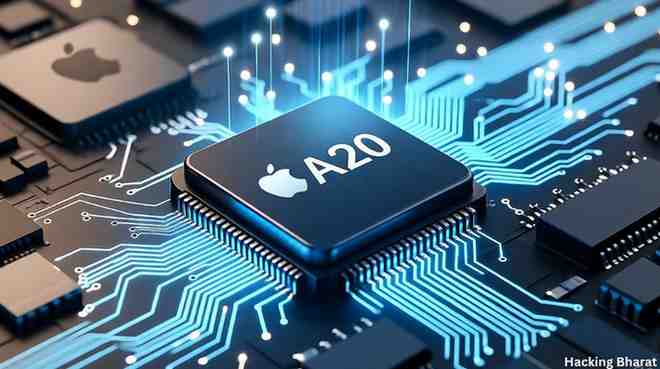
Apple is preparing another significant technological breakthrough with its next A20 chip, which would drive the next generation iPhones.
The new chip will live up to industry expectations, the industry sources suggest that this chip will be able to provide better performance and AI technology, yet at the same time, it may make future iPhones more expensive than at any time in history.
A20 Chip: It is smaller, smarter, and more costly
The A20 is expected to be manufactured on the 2 nanometer process by TSMC (500 nm improvement over the 3 nm used in the A17 and A18) chip.
The new architecture will be much faster in processing capabilities, energy consumption, and AI.
Apple can lower the size of the transistor and place more computing power in the same size to achieve an iPhone with the ability to perform many tasks at once and use less power.
This implies that the users will get improved gaming, quicker processing of photos and videos, and improved battery life at a lower power consumption.
The price of creation and production of these sophisticated chips is very high, though.
Two Nm is the process that has been manufactured by TSMC and is considered to be one of the most costly semiconductor technologies ever manufactured.
It has been reported that all chips may cost between 25% and 30% more than the current generation, and this will compel Apple to re-evaluate how it should price its next-generation iPhone 17 series.
It is believed that analysts will transfer these additional costs to the consumers as Apple tries to sell the iPhone as a high end AI powered smartphone.
The A20 chip may make flagship iPhones easily exceed the prices at present because of inflation and global supply chain issues.
Artificial Intelligence and Next Generation iPhone Experience
In addition to performance, the Apple A20 chip will likely be used as the primary contributor to the growth of on device artificial intelligence (AI).
Generative AI has already started to be implemented into iOS by the company, which would provide a smarter Siri, better text generation, and even smarter camera intelligence.
The A20 chip may go even further with these features to include real time language translation, advanced photo editing, and personalized recommendations, and it might even add some newer flavors of augmented reality experiences.
This would be able to enable iPhones to be more self sufficient, and they would not need to have their processing done in the cloud.
Analysts are attributing this change of on device AI to the long term strategy Apple has in enriching its privacy and performance.
Direct processing of data on the device will make the iPhone speedier, safer, and less reliant on the internet.
Although Apple is yet to prove information on the A20 chip or even the iPhone 17 series, it is anticipated to start manufacturing them in mid 2025.
Apple follows the traditional launch cycle, so the first devices on the basis of this new chip might be announced in September 2025.
With the growth of technology, Apple has been carrying on the frontiers of mobile innovation.
The A20 chip can be a significant leap in the performance of the smartphone and it may also carry a premium price amount, which may put even the staunchest Apple enthusiasts to the test.
.