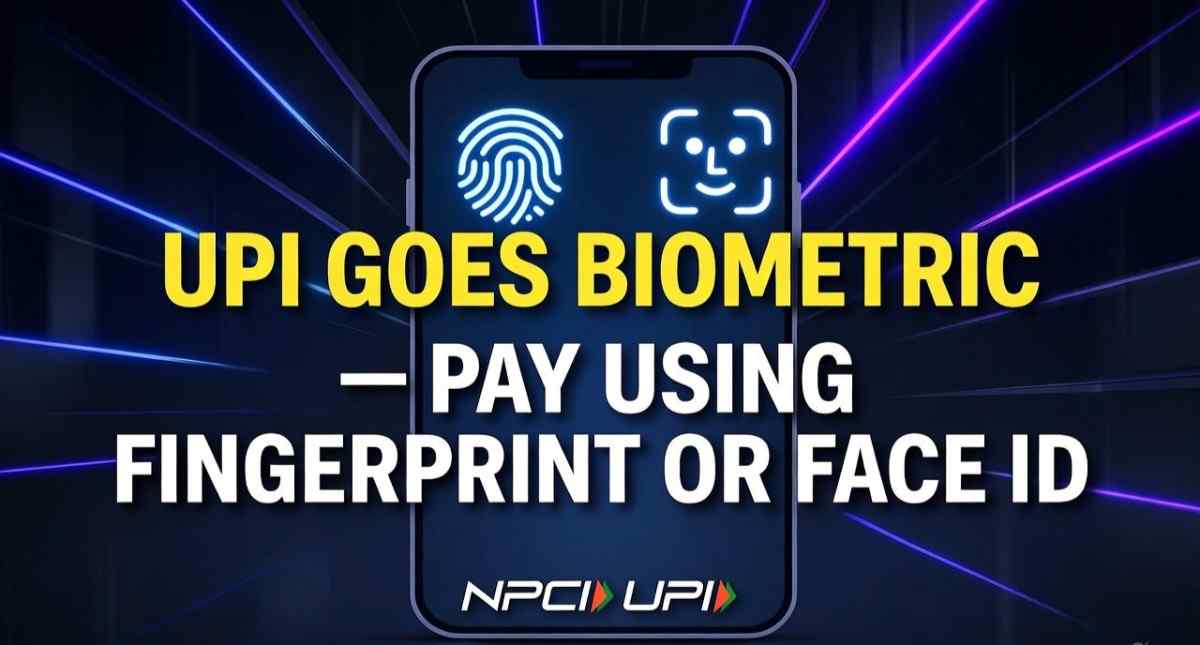
In India, a new card payment option that may transform the online payment process of millions of Indians is spearheaded by the National Payments Corporation of India (NPCI).
Users are able to now authenticate the transaction of their UPIs with their face or fingerprint as opposed to entering a PIN.
This is a newly developed system, which is known as the NPCI UPI biometric authentication, whose objective is to ensure that everyone is in a position to transact faster, secure, and convenient online payments.
The update was announced during the Global Fintech Fest in Mumbai, at which M. Nagaraju, Secretary of the Department of Financial Services, announced the update.
According to him, the new biometric system will ensure that not only will payments not be dishonest, but also negligence of frauds associated with sharing PINs and stealing passwords will be reduced.
The Biometric UPI System Operation
The new UPI fingerprint authentication option requires your phone’s inbuilt security applications, such as fingerprint scanners or facial recognition, to acknowledge your payment before undergoing a payment transaction.
This implies that users do not need to call a UPI PIN each time that they need to transfer money.
Here’s how it works
When you make a UPI payment, you will first be asked to scan your fingerprint or face. After identity verification, a payment will immediately be made.
The biometric data also remains within your device, not distributed among the banks or NPCI thus, privacy and security are delivered.
This UPI biometry system of face identification payment is voluntary. In case the users feel like typing their PIN like earlier, they are free to do it.
According to NPCI, the biometric functionality will be introduced to some of the banks and UPI applications before being released to all individuals in India.
M. Nagaraju also remarked that this feature will assist older adults and incentive users on digital platforms (love to use it) that do not find PIN-based systems intuitive.
Doing away with typing or number recall, NPCI believes that UPI payments should become more reachable by all hierarchy layers in the society.
Making payments safer and easier
UPI plus will be used by millions of individuals with design UPI without PIN, as they already use biometric authentication to unlock phones or place applications.
The idea is to pay users for things like taking a selfie or swiping your phone screen.
Security experts feel biometric verification would help prevent unauthorized transactions since it is difficult to defraud employees through fingerprints or facial features in comparison with passwords or PINs.
Nevertheless, NPCI guarantees the users that they will never be forced to change to using conventional means, as they might not wish to do so.
The feature has been introduced at a time when the use of digital payment in India is highest.
Recent statistics indicate that within a short period of one month, more than $12 billion UPI transactions have been carried out, which is evidence of the permeability of UPI into the irremissibility of life, from vending groceries to settling bills.
Industry analysts assume that NPCI UPI’s new feature will consolidate India as a digital finance innovation leader in the world.
It also goes in line with the objective of the government making the digital transactions more convenient and secure.
Such an action will motivate other players in the fintech sector to use the same biometric purchasing scheme.
Already, biometric UPI India style systems are an idea that many global companies are searching to achieve, as they are perceived to be the future of cashless payments.
To the users, it only comes out with fewer steps, less inconvenience, and quicker methods of payment. There is no longer any need to search for your PIN or fear making typing mistakes, simply tap, scan, and go.
Want to know how biometric payments are going to transform the future of digital finance, particularly? Then keep an eye on further developments on the spreading UPI ecosystem at NPCI and future AI-driven fintech applications.